Professor Ryan Kerney, Biology
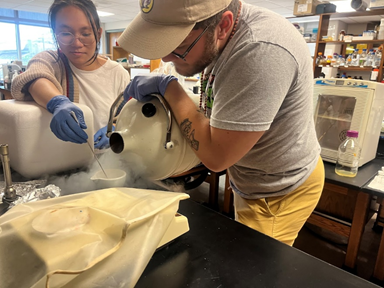
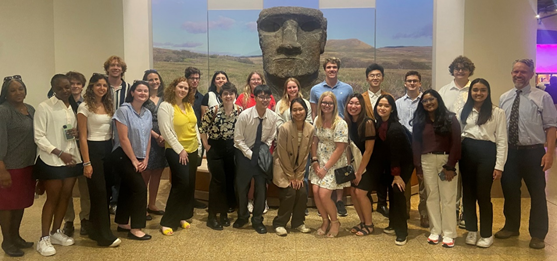
The Kerney lab had a busy summer in 2024 with Noah Wolf (BMB ’26) and Trang (Rachel) Nguyen (Chem ’26) participating. Both worked on a range of projects that got them into the field and working away in the lab. We also worked with Tracie Potts from the Eisenhower Institute for our first ever “Science Policy Summit” in Washington, D.C. Participants heard from a wide range of scientists and policymakers and also found time to take a short walk to the Smithsonian Natural History Museum in Washington D.C. We have recently had work from Elliana Vickers (Bio’20) and River Larson-Pollock (BMB ’21) on algal symbiont phylogeography accepted to the journal Oikos.
Tim Funk was on sabbatical during the 2023 – 2024 academic year and did not take any research students during the summer of 2024. His main research-based goals: complete our work on the use of furfural as a hydrogen acceptor in the iron-catalyzed oxidation of alcohols, and synthesize and collect biological data on a small class of triazine-based lipids. Missions accomplished!
We have been working on the iron/furfural project since the summer of 2018, when we discovered that furfural—derived from cellulosic biomass, a sustainable resource—served as a hydrogen acceptor when used with our air-stable, inexpensive iron catalysts. Melanie Hempel (’20 BMB) did all the initial reaction optimization, and a collection of students worked on the project over the years to explore the substrate scope and improve the purification method. Around the time we started this project, we also discovered that careful selection of the hydrogen acceptor and catalyst could lead to selective oxidations of primary or secondary alcohols. Kim McCaskey (’20 Chem and Music), Auden Cameron Lampariello (’22 Chem), and Nicolle Elahian López (’24 Chem) all made important contributions to the selective alcohol oxidation aspect of this project. We wrote the manuscript titled, “Selectivity Effects of Hydrogen Acceptors and Catalyst Structures in Alcohol Oxidations Using (Cyclopentadienone)iron Tricarbonyl Compounds” this fall and it was accepted for publication in The Journal of Organic Chemistry during the last few days of 2024! Gettysburg College student co-authors include Melanie Hempel, Auden Cameron Lampariello, Nicolle Elahian López, Kim McCaskey, Cole Springer (’25 Chem and German Studies), Sneha Jayaram (’25 Chem), Katy Wnuk-Fink (’22 Chem and Bio), and Bryn Werley (’23 Chem and Music).
In addition to completing older projects, the sabbatical provided Prof. Funk an opportunity to make progress on a newer project. Since 2020 (a great year to start a research collaboration), we have been collaborating with Prof. Vincent Venditto (’03 Chem) at the University of Kentucky College of Pharmacy to synthesize a novel class of triazine-based lipids for use in RNA vaccines. Peter Heyang Zhang (’21 BMB), Emily Howe (’23 BMB), Tommy Megna (’23 BMB), and Emily Sullivan (’24 BMB) have all worked on the project, and Prof. Funk was able to make a library of 12 lipids and optimize the synthetic approach based on their contributions. He spent three weeks in Prof. Venditto’s lab to learn how to prepare and collect physical property data on lipid nanoparticles (LNPs) derived from his lipids, and he also participated in the cellular assays used to determine how well they delivered RNA into cells. He had a great experience in Lexington, including meeting and working with his students and developing an appreciation for bourbon. Based on the promising results from these studies, Profs. Funk and Venditto submitted a grant to the NIH for funding for this collaborative project. As the fall 2024 semester began, two new students started on the project: Liz Hackley (’25 BMB) and Rachel Nguyen (’26 BMB).
Prof. Funk gave an invited oral presentation at Ursinus College in February titled, “Safe and Sustainable? Iron Catalysts for Alcohol Oxidations and Carbonyl Reductions.” He also spoke at the University of Kentucky College of Pharmacy’s Everything is Science five-day, public outreach event in late February. The theme for the event was “Make it Make Sense,” and each of the five evenings was dedicated to one of the five senses. His talk, titled, “Controversial Chemistry: How the Public Views the Central Science,” was part of the “vision” evening. He also presented a poster titled, “Mechanistic Insights into Transfer Hydrogenations and Dehydrogenations with (Cyclopentadienone)iron Carbonyl Catalysts” at the New Orleans American Chemical Society Meeting in March. Back on Gettysburg’s campus, he gave two presentations this past fall: “Vaccines, Synthetic Fats, and Bourbon: A Sabbatical Story” at a Friday Forum and “Making Molecules: Synthesis of Triazine-Based Lipids for Nucleic Acid Delivery” as part of the BMB seminar series.
Professor Véronique Delesalle, Biology
Véronique Delesalle‘s lab continues to focus on bacteriophages, the viruses that eat bacteria. In 2024, we published a couple of manuscripts describing the genomes of phages, based on the work Gettysburg students (underlined) did in Bio 214, Phage Genomics, as well as collaborators from the SEA-PHAGES program.
Delesalle, V.A., M. King, T. Rozario, N. Wolf, S. Connor, L. DeMato, K. Trafford, S. Adhikari, V. Dinh, G. Caputo, A. Hunter, M. Licata, M. Modell, and S. Bhalla. Complete genomes of two cluster AK Arthrobacter phages isolated from soil samples in Newburgh, NY, United States. Microbiol Resour Announc. 2024 Sep 12:e0071624. doi: 10.1128/mra.00716-24. Epub ahead of print. PMID: 39264183.
Delesalle, V.A., R.E. Ankeriasniemi, C.M. Lewis, J.M. Mody, A.M. Roy, W.A. Sarvis, D.D. Vo, A.E. Walsh, and R.J. Zappia. Introducing Casbah, Kronus and MmasiCarm, members of the mycobacteriophage subcluster B3. Phage (New Rochelle). 2024 Jun 21;5(2):84-90. doi: 10.1089/phage.2024.0004. PMID: 39119203; PMCID: PMC11304909.
Professor Steve James, Biology
Our lab continues to study a new-to-science gene and protein that governs the stability of the microtubule cytoskeleton. When the gene, which we named wdA, is mutated, microtubules become unstable at low temperatures and cells undergo lethal mitotic catastrophe. We would love to know how this novel gene acts to maintain microtubule stability, as it is common to fungi, but absent from animals and plants. Crucial to this understanding is to identify partner genes and proteins that interact with wdA, and thus to reveal the multi-protein complex through which wdA operates. Using techniques of genetics, protein biochemistry and genetic engineering, current experiments seek to identify these binding partners and thereby reveal the wdA role in microtubule homeostasis.
We have discovered several genes that exhibit genetic interactions with wdA, and we are proceeding to test whether their proteins associate physically with the wdA protein. In 2023-24, Kyle Miller (Bio ’24) engineered amino acid changes into a microtubule-binding protein, End-binding Protein A (ebA), and assessed its effect on microtubule stability. Alessandro Zuccaroli (BMB ’25) is using genetic engineering and fluorescence microscopy to perform a structure/function study of mcnC, a gene we identified by mutations that interact by alleviating (rescuing) defects in wdA and thereby restoring microtubule homeostasis. Merlin Phan (BMB, ’26) is using genetic engineering to add a biochemical tag another wdA-interacting gene, Tubulin-binding Cofactor A (TBCA), to facilitate co-immunoprecipitation studies that will test for protein-protein interaction. Mark Vo (BMB ’25) and Jonathan Zhuang (Bio ’24) created new combinations of microtubule mutants via genetic crosses, for use in genetic engineering experiments. Finally, Sarah Neczesny (IDS ’25) has undertaken a forensic project, using DNA sequencing, to identify the range of contaminant fungal species living in the Science Center and McCreary Hall. This project will provide a baseline to understand the diversity of fungi endemic to our buildings. Sarah has so far identified 5 species common to the Science Center, including one that is a known pathogen on apples. Alessandro, Sarah, and Merlin were X-SIG summer students during 2024, and presented their research posters at the fall 2024 X-SIG symposium during Family Weekend.
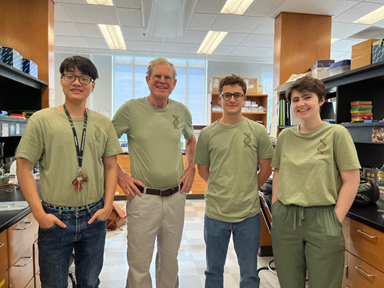
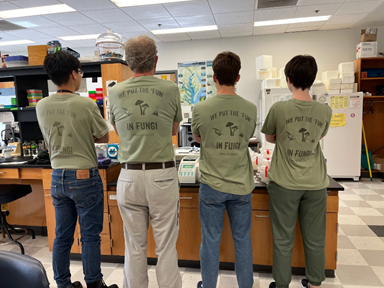
Summer researchers — (L to R) Merlin Phan (’26), S. James, Alessandro Zuccaroli (’25), and Sarah Neczesny (’25). Putting the fun in fungi!
Professor Kurt Andresen, Physics
Kurt Andresen’s research group continued to work on a variety of projects related to the electrostatics of nucleic acids. Over the summer, Kyle Shaffer, Eden Levkov, and Maya Pabis joined the group. Kyle and Eden delved deep into biochemistry to produce high-quality nucleosome core particles that could be used in research into the electrostatics of nucleosome packing and nucleosome formation. Maya began a new molecular dynamics simulation branch of the Andresen research group, looking at trivalent ion binding to DNA. Returning researcher Macyn Rosay continued her research into calorimetric studies of trivalent ions binding to DNA. In February, Professor Andresen traveled to Philadelphia for the annual Biophysical Society Conference with Macyn Rosay and Aubrie Hetherington. Aubrie and Macyn presented their poster “Isothermal titration calorimetry studies of DNA condensation through cobalt hexammine”.
Professor Kate Buettner, Chemistry
The Buettner lab continued their work on developing de novo proteins to function as hydrolases, and the development of mimics of natural haloperoxidase enzymes. Ethan Clare (’25 Chem) continued in the lab for the academic year, looking to understand metal binding in our proteins, and went on to Texas A&M University for the summer where he worked in the Altman lab, and now he is back wrapping up his projects before he moves on to graduate school next year. Last Spring, he and Bonnie Coley (’25 Chem) presented their work at the National American Chemical Society meeting. Bonnie continued her work on understanding vanadium binding to our haloperoxidase proteins, and picked up some work on Ethan’s projects while he was away for the summer. Savarna Goutam (’26 Chem and HS) and Sarah Marcus (’26 Chem) also continued in the lab through the year and summer, working on the reactivity of our proteins both as hydrolases and haloperoxidases. In the Spring of 2024, Raphael (Rudy) Rudatsikira (’27 BMB) joined the lab last spring to begin some work looking at vanadium binding environments by NMR, and redesigning our active sites to better mimic haloperoxidases, which he worked on over the summer, and he picked up some of Sarah’s work while she was abroad in Berlin, Germany. Starting in the summer, Israel Fuentes Juarez (’25 BMB) began looking into using our proteins to model a new class of proteins, and is taking on some new vanadium work this spring. In June, Prof. Buettner was invited to be a discussion leader at the Metallocofactors Gordon Research Seminar, which was organized by lab alum Olivia Peduzzi (Chem ’20), it was great to get to catch up with her and see all the great things she is doing as she nears the end of her Ph.D. This spring, Julia Brock (’28 undeclared) joined the lab to begin to learn the work that Ethan and Bonnie have been doing so that she will be ready to fully take over when she graduates.
Professor Shelli Frey, Chemistry
In Lipid Lab, Prof. Frey continued work focused on understanding interactions of exogenous biological agents (currently neurodegenerative proteins and detergents) with cell membrane interfaces. In Spring 2024, two students, Andrea Brazyte (’24 Chem) and Vy Tran (’25 Chem and Bio), worked together to further develop membrane permeability assays to study detergent-mediated membrane disruption mechanisms en route to finding eco-friendly detergents to be used in bio-manufacturing processes. Over the summer, Vy had an REU experience at Syracuse University with Dr. Alaji Bah at SUNY Upstate Medical University where she worked on characterizing the salt dependency of the phase separation behavior of the wild-type Pol II CTD of S. cerevisiae and its two mutants YDA9 and pYSA. During the summer months, Prof. Frey concentrated on her Huntington’s disease project, looking at the effect of certain post-translational modifications on protein-interface binding and how these interactions could be modified with changes in membrane curvature and charge. This work is being done with Silvina Matysiak from UMaryland and their first collaborative manuscript is current under review. This fall, Vy was joined in the lab by River Pham (’26 BMB) and Molly Rossncock (’27 Chem). Vy is quantifying the thermodynamic parameters of detergent-membrane interactions using isothermal titration calorimetry while River and Molly focus on relating detergent structure to its membrane permeability mechanism. This spring, Lipid Lab will also take advantage of the brand new shared confocal microscope facility at Mount St. Mary’s University as Frey was a senior personnel on the NSF-MRI proposal for the instrument; there are plans to implement the microscope in both research and coursework.
In February 2024, Prof. Frey traveled to Philadelphia to present a poster titled “Divalent cations promote huntingtin fibril formation on endoplasmic reticulum membranes” at the annual Biophysical Society meeting. She presented the same work at the American Chemical Society annual meeting in New Orleans in March 2024, first as a talk and then as a poster in Sci-Mix, an interdivisional poster session and social hour. This work, performed with Jordyn Markle (’22 BMB), resulted in a publication with long-time collaborator Justin Legleiter from WVU (A Skeens, JM Markle, SL Frey, and J Legleiter. Divalent cations promote huntingtin fibril formation on endoplasmic reticulum membranes. BBA:Biomembranes, 2024, 1866, 184339). Another project with Legleiter, focused on the expanded polyglutamine region of the huntingtin protein as a seed for protein aggregation, came to fruition with a PLOS One publication (A Skeens, C Siriwardhana, SE Massinople, MM Wunder, KM Keith, T Girman, ZL Ellis, SL Frey, and J Legleiter. The polyglutamine domain is the primary driver of seeding in Huntingtin aggregation. PLOS One, 2024, 19(3), e0298323). Work on the detergent project from Prof. Frey’s sabbatical at the Translational Nanobioscience Research Center at Sungkyunkwan University in South Korea resulted in a publication with new collaborator Josh Jackman (N Gooran, SW Tan, SL Frey, JA Jackman. Unraveling the biophysical mechanisms of how antiviral detergents disrupt supported lipid membranes: Toward replacing Triton X‑100. Langmuir, 2024, 40, 6524-6536). Frey also started a new project to characterize sponge phase lipid nanoparticles as encapsulation vessels and had a manuscript detailing this early work with Jackman and Prof. Tommy Nylander of Lund University accepted by Langmuir earlier this week.
Professor Emily Dieter, Chemistry
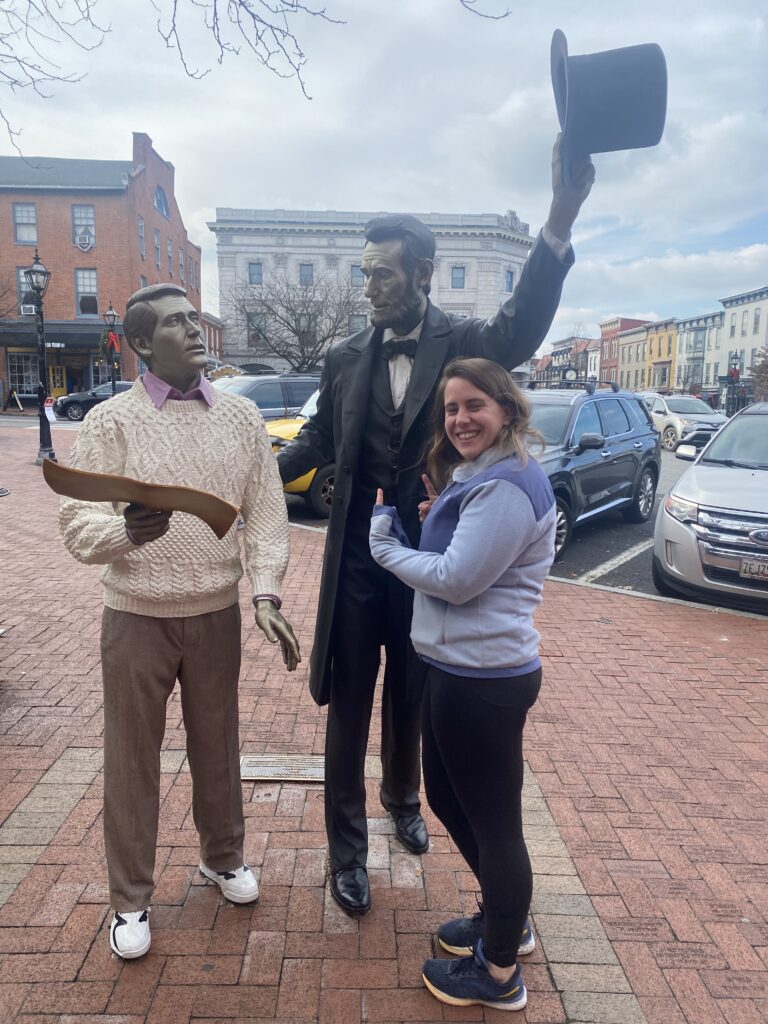
Hello! I’d like to formally introduce myself! I am Professor Emily Dieter, the newest member of the Gettysburg College Chemistry Department and the BMB program! I come to Gettysburg College following a stint as a postdoctoral researcher in the lab of Professor Joan Broderick at Montana State University, where I worked on novel Fe-S binding proteins in methanogens. Before Montana, I somehow got lucky enough to spend the worst of Covid working in Sydney, Australia as a Research Officer (Australia’s terminology for a postdoc) at the Children’s Medical Research Institute. As a Research Officer, I investigated signaling pathways initiated by an ALK kinase fusion, a protein that has been implicated as the driver of a rare, aggressive pediatric cancer. Outside of lab, I made a point to visit as many beaches as possible. I got very good at snorkeling and am now able to sit on a surfboard (although I am still not able to ride a wave…) I obtained my PhD at the University of Washington under the guidance of Professor Dustin Maly, where I studied non-catalytic functions of Src-family kinases, as well as intracellular RAS signaling. Fun fact: I am also on a patent with Professor David Baker, which was exciting because I actually got some money from it for a bit, but it became a much bigger highlight on my resume this year when David got the Nobel Prize in October! Continuing on through the backwards trek through my life, I attended Saint Michael’s College in Vermont where I got a B.S. in Biochemistry with minors in math and physics. As an undergrad, I worked in both an organic synthesis lab at St. Mikes, and a maize genomics lab at the University of Missouri. The summer that I spent in the field cutting corn leaves under the hot Missouri sun solidified that I wanted to focus on biochemistry/microbiology in a lab, rather than being in the field. After all this moving around, I am SO EXCITED to be at Gettysburg to establish my own lab and teach Biochemistry! It has been a whirlwind so far, but I have (mostly) enjoyed every second, and I am looking forward to having my first research students as part of X-SIG this summer!
